For about ten years the honest answer to “is Airbnb legal in Korea” was a shrug. The law was clear enough; enforcement was not, and plenty of listings operated outside it. That period ended, and it ended on a specific date that almost no travel guide has caught up with.
What changed, and when
Airbnb did the enforcing itself, in two steps.
From 2 October 2024, any new Korean listing had to submit its registration details and a 영업신고증 (yeongeop singojeung, the business registration certificate**)** before it could be sold. From 16 October 2025 the same requirement applied to every existing listing in the country. Listings that had not submitted were blocked from accepting bookings for stays from 1 January 2026 onward — a deadline Airbnb deliberately pushed past the autumn season so that visitors already holding reservations were not stranded.
The door was left open: a host who uploads the certificate later goes back to normal operation from the moment they submit.
The practical consequence for you is simple. A Korean listing that can accept your booking today has had to show a licence. That is a genuinely different situation from the one every older article describes, and it is why “is Airbnb legal in Korea” is now a question about which licence, not whether.
The law underneath it
Running lodging without registering is not a technicality. Under the 공중위생관리법 (gongjung-wisaeng-gwallibeop, the Public Health Control Act**)**, operating a lodging business without filing carries up to two years’ imprisonment or a fine up to 20 million won. The statute singles lodging out: every other kind of public hygiene business gets half that.
That liability belongs to the host. Guests are not prosecuted for booking. Your risk is of a different kind — a reservation cancelled at short notice because the listing came down, a building that no inspector has looked at, and no one to complain to afterwards.
The licence that forbids Korean guests
Here is the rule that surprises people, and it explains a lot of otherwise odd host behaviour.
Home rentals in Korean cities run under a licence whose name translates as foreign tourist city homestay — 외국인관광도시민박업 (oegugin gwangwang dosi minbagop). To register it, three things must hold:
- The home must be under 230 square metres
- The host must actually live there — residence is a condition of the licence
- The guests must be foreign tourists; Korean guests are excluded
So if your host lives downstairs, that is not an eccentric arrangement. It is the licence working as designed. And if you were planning to have a Korean friend stay the night, that specific category of accommodation is the one place it is not allowed. Hotels, motels, registered guesthouses and hanok stays carry no such restriction.
Airbnb, for its part, has publicly argued that the residence obligation, the building-type limits and the ban on Korean guests are out of step with how the rest of the world regulates this, and has asked for the rules to be loosened. As of now they stand.
Hanok stays play by different rules
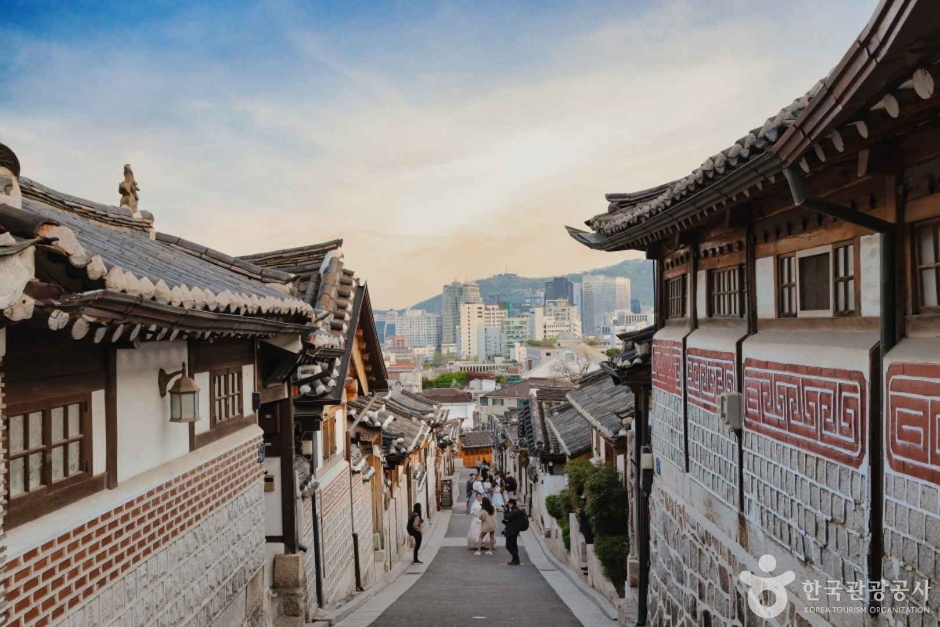
A night in a hanok runs under 한옥체험업 (hanok-cheheomeop, the hanok experience licence**)**, and the differences are worth knowing before you compare prices.
Guest space is capped at under 230 square metres, and the building has to be a real hanok rather than a hanok-styled one: Korean-tile roofing, timber structure, eaves of at least 90 centimetres. Every room needs a smoke alarm, a carbon monoxide alarm and a fire extinguisher — a sensible requirement in a wooden building with underfloor heating.
The important difference is what is not required. There is no obligation for the operator to live on site. That is precisely why a hanok stay can hand you an entire courtyard house with nobody else in it, while a city apartment on the same platform comes with a resident host. Two licences, two experiences.
Out in the countryside the pattern returns to the city model: 농어촌민박 (nong-eochon-minbak, rural homestay**)** is capped at under 230 square metres and requires the owner to live in the house.
What to actually do when booking
Most of this resolves into a few habits.
Book on a platform that checks. Since January this year, Airbnb’s Korean listings have had to produce a certificate to stay bookable, which does the verification for you. Smaller or local short-term-rental sites have no equivalent obligation.
Read the description for the residence clue. A city home rental describing a host who lives in the building is showing you a compliant listing, not a compromise.
Treat coaching as a warning sign. If a host asks you to tell neighbours or a building manager that you are a visiting friend, or not to mention the booking, that is what an unlicensed operation sounds like.
Bring your passport to check-in. Every registered form of accommodation will ask foreign guests for it.
For the surrounding practicalities, the first-timer’s Seoul itinerary covers where it makes sense to base yourself, getting in from the airport covers the arrival, and if you are chasing a season rather than a city the festival and season calendar is the place to start.
The city homestay and hanok licence conditions are from the Tourism Promotion Act and its enforcement decree; the rural homestay rule from the rural development law; the penalty for unregistered lodging from Article 20 of the Public Health Control Act, which sets a higher penalty for lodging than for other regulated businesses; the platform dates and the argument for loosening the rules from Airbnb’s own announcements and Korean press coverage of them. Checked 9 September 2026. Rules of this kind are actively debated in Korea and may move — check before you book if it matters to your plans.