Search for Korean air quality and you will mostly find articles describing 2016. The picture has changed enough that the old advice is now misleading in both directions: the sky is clearer than the reputation, and the number on your phone probably is not measuring what you think it is.
Start with the trend, not today’s reading
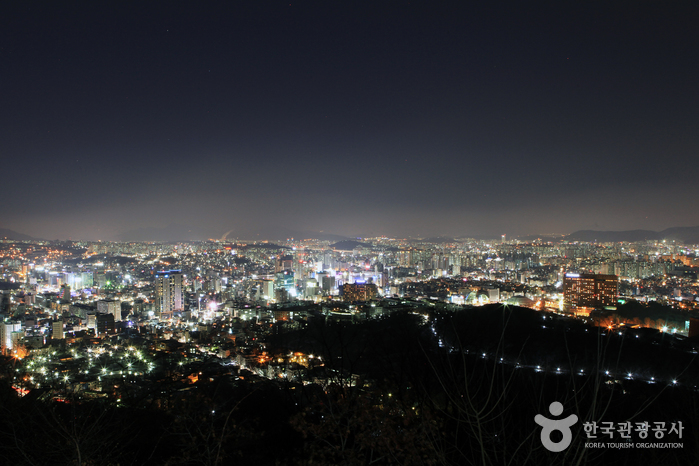
Seoul’s annual PM2.5 average was 30 micrograms per cubic metre in 2006. In 2025 it was about 18 — a fall of roughly 40%. Over the same period the number of days graded good rose from 73 to 182, and the days graded bad fell from 108 to 32. Those are the city government’s own figures.
The honest qualifier: Korea’s national standard for PM2.5 is 15 micrograms per cubic metre as an annual average and 35 over 24 hours. At 18, Seoul is still above its own annual limit. This is a city that has cut its pollution a long way and has not finished.
The part that confuses everyone: two rulers
Korea grades PM2.5 in four bands, by concentration:
- 0–15 — 좋음 (joeum), good
- 16–35 — 보통 (botong), moderate
- 36–75 — 나쁨 (nappeum), bad
- 76 and above — 매우나쁨 (mae-u nappeum), very bad
The United States EPA index, which is what most international apps show, was revised in 2024 so that an index value of 50 — the top of the green “Good” band — now sits at 9.0 micrograms. The value of 100 sits at 35.4.
Put those side by side and the disagreement is specific rather than vague. Around the 35 mark the two systems almost coincide. But everything between 9 and 15 micrograms is “good” in Korea and “moderate” on a US-scale app. That is an extremely common reading in Seoul, which is why a visitor’s phone can show a cautionary yellow while every Korean around them is behaving as though the day is fine. Both are reporting the same air correctly.
There is a third number to know about. AirKorea’s own English pages report a 0 to 500 index with the labels Good, Moderate, Unhealthy and Very Unhealthy — not the microgram figure that Korean-language users see. Three presentations, one atmosphere.
When it is actually bad
You do not have to guess the season, because the government has defined it. Since 2019 Korea has run a seasonal management period (계절관리제) from 1 December to 31 March, the months when concentrations reliably climb. During it the oldest and dirtiest category of vehicle is barred from Seoul and the surrounding metropolitan region, with a 100,000 won daily fine for driving one anyway. If you want a single sentence about timing, that is it: winter into early spring is the season, and the state agrees.
Spring brings something different that often gets filed under the same heading. 황사 (hwangsa), yellow dust, is mineral dust lifted from the Gobi desert and the Inner Mongolian plateau and carried east on the wind. It is not the same material as the combustion particles that dominate a winter smog day, and it arrives as episodes rather than a background level. The scale is worth knowing: a formal yellow dust warning requires PM10 of 800 micrograms per cubic metre, hourly average, sustained for two hours. Ordinary bad days do not come close to that, which tells you how unusual a genuine dust event is.
Alerts are separate from the four grades and are worth recognising if you see one in the news. For PM2.5, a watch is issued at 75 micrograms sustained two hours and is lifted below 35; a warning at 150, lifted below 75. For PM10 the same structure applies at 150 and 300.
What Koreans actually do about it
Less than the alarming version of this story implies. The official guidance for the general public on a bad day is to limit long or strenuous outdoor activity, and to avoid being outside if you already have a cough or a sore throat. Even at very bad, the advice to a healthy adult is the same restriction, more firmly worded. It is people with asthma, heart or lung conditions, young children and the elderly who are told to move activity indoors and, at the worst grade, to talk to a doctor.
Translated into a trip: on a bad-air day, swap the long hike for a museum, a palace visit or an indoor market. Do not cancel the day.
Masks are easy to find and cheap — every convenience store and pharmacy sells them. The KF rating is a Korean regulatory standard, and the numbers are filtration percentages: KF80 blocks at least 80% of particles averaging 0.6 micrometres, KF94 at least 94% of 0.4 micrometre particles, KF99 at least 99% of the same. The drug safety ministry’s own advice is mostly about fit — a mask worn under the nose or parked on the chin is doing nothing, whatever is printed on it.
Checking before you go out
AirKorea is the official source, run by the Ministry of Environment and the Korea Environment Corporation, with hourly readings by region, forecasts and an English site. Korean weather and map apps carry the same grades, which is usually the fastest route: the forecast you already look at will show today and tomorrow. Seoul runs its own air quality service as well.
If you keep an international app, keep it — just remember which ruler it is using, and that a yellow “moderate” in Seoul frequently means air that Korea considers good.
For planning around the season rather than the day, the festival and season calendar covers what is worth travelling for month by month, and the winter packing guide covers the rest of what December through March asks of you. If the forecast is clear and you want to be outside, Seoul’s mountains start inside the city.
Grade bands, the national standards and the watch and warning thresholds are from the Ministry of Environment and AirKorea; the yellow dust warning criterion from the Korea Meteorological Administration; the KF mask filtration figures from the Ministry of Food and Drug Safety; the seasonal management period and vehicle restriction from government and Seoul city announcements; Seoul’s long-term trend from figures released by the city and reported in May 2026; the United States index revision from the EPA. Checked 9 September 2026. Readings change hourly and standards are revised — check the live source on the day.