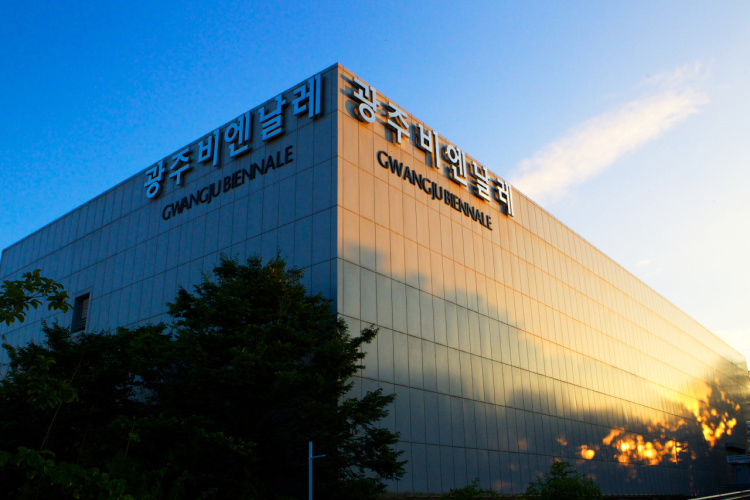
The Gwangju Biennale (광주비엔날레), founded in 1995, is an international contemporary art exhibition held in Gwangju. The 16th edition, 《You Must Change Your Life》, runs Saturday 5 September to Sunday 15 November 2026. The main exhibition fills one building, the Gwangju Biennale Exhibition Hall in Buk-gu, and pavilions run by countries and institutions are spread across the city.
Official site: gwangjubiennale.org. Checked on the official site, 1 October 2026. Prices, hours, closed days, venue names and bus routes below come from the Foundation’s own pages on gwangjubiennale.org, mostly the Korean visitor pages, because the English “Admission Fees” and “Hours & Information” tabs were empty when we checked. A few visit rules come from the edition’s official exhibition site, youmustchangeyourlife.kr, which gwangjubiennale.org names as the 16th Biennale’s official website. Where the Foundation doesn’t say, we write “not published”.
The short answer
- When: Sat 5 September – Sun 15 November 2026. Hall hours 10:00–18:00, last entry 17:30, closed Mondays (but open Monday 5 October).
- Theme: 《You Must Change Your Life》 (너는 네 삶을 바꿔야 한다), after the last line of Rilke’s poem “Archaic Torso of Apollo”. Artistic director Ho Tzu Nyen; 43 artists and teams from 22 countries.
- Ticketed vs free: the main exhibition is in the Exhibition Hall and needs a ticket. Gallery 5 can be entered from the Biennale Plaza without a ticket. Admission to the pavilions around the city is not published.
- Adult ticket: 20,000 won (youth 10,000, child 7,000).
- How to buy: the official page links one online seller, the Interpark (NOL) Ticket listing. No English or foreigner route is published, so buy at the on-site ticket office.
- From Seoul: KTX to Gwangju Songjeong Station, then a city bus or taxi to the hall (about 15 km, 35 minutes by car).
Tickets
The Foundation’s Korean ticket page (티켓정보, checked 1 October 2026) lists these prices:
| Ticket | Adult (19–64) | Youth (13–18) | Child (4–12) |
|---|---|---|---|
| Regular, from 5 Sep | 20,000 won | 10,000 won | 7,000 won |
| Advance (28 May – 4 Sep) | 17,000 won | 8,000 won | 5,000 won |
| Repeat visit | 10,000 won | 5,000 won | 3,500 won |
| Group (20 or more people) | 18,000 won | 9,000 won | 6,000 won |
| Special discount (see below) | 6,000 won | 4,000 won | 3,000 won |
- Advance sales are over: that price ended on 4 September.
- Special discount covers, among others, visitors aged 65 and over, people with some disabilities and one carer, and Korean conscripts. The page does not say whether a foreign passport counts for the 65+ rate (not published).
- Free: children aged 3 and under (not in child groups), plus several groups under Korean veterans’ and disability law.
- Other discounts on the page need specific proof: a Jeonnam-Gwangju integration discount (14,000 / 7,000 / 4,900 won), an artist pass (14,000 won), a Yeosu island expo ticket-holder discount (14,000 / 7,000 / 4,900 won) and a Korea art festival adult ticket (10,000 won, limited to 3,000). Who qualifies for the integration discount is not spelled out on the page.
- Proof at the ticket office: every discount and free entry needs ID or a document shown at the on-site ticket office (현장 매표소), and only the holder can use it.
Where to buy. The page’s booking button goes to one seller, the Interpark Ticket listing. The “Purchase Tickets” link on the edition’s site goes to the same listing number on NOL Ticket. The Foundation publishes no English or foreigner-specific booking route, and nothing on whether foreign cards or phone numbers work, so the practical answer for overseas visitors is to buy on site at the Exhibition Hall ticket office. Nothing on the official pages says tickets sell out or that a time slot is needed.
Venues and hours
Gwangju Biennale Exhibition Hall (광주비엔날레전시관)
Address: 111 Biennale-ro, Buk-gu (비엔날레로 111), per the official directions page. The Foundation says this edition’s main exhibition is held in this one building only, across five galleries:
- Gallery 1: Molecules and Me
- Gallery 2: Bodies and Bonds
- Gallery 3: Landscapes and Learning
- Gallery 4: Cosmos and Change
- Gallery 5: Air and Articulations. Free: the Foundation’s opening press release says you can walk in from the Biennale Plaza without a ticket.
Hours (이용안내, checked 1 October 2026):
- Tuesday to Sunday, 10:00–18:00. Last entry 17:30.
- Closed every Monday, except Monday 7 September, Monday 5 October and the Chuseok holiday. That leaves 12, 19 and 26 October and 2 and 9 November as closed Mondays.
- Art shop: Tue–Sun 10:00–18:00, public holidays 10:00–20:00. Café: Tue–Sun 10:00–18:00. Both closed Mondays on the same pattern.
Things that happen at set times, from the Foundation’s press releases (3 and 29 September 2026):
- James T. Hong, Apology: projected on three outside walls of the hall facing the Biennale Plaza every evening, 19:00–21:00, after the galleries close.
- Angela Goh, Craft: live four times a day on the outdoor bridge between Galleries 2 and 3. Exact times are not published.
Visit rules from the edition’s site (youmustchangeyourlife.kr, Visit section): no touching the works; no food, pets or long umbrellas; heavy bags go to the storage area; no selfie sticks, flash or tripods in the galleries. Ask staff for the nursing room and wheelchair or stroller loans.
The pavilions
Pavilions are separate shows by countries, cities and institutions in venues around Gwangju. The Foundation’s latest count (press release, 29 September 2026) is 26 pavilions in 27 venues. The pavilion page on gwangjubiennale.org (제16회 광주비엔날레 파빌리온) lists 27 participating countries and institutions in 28 pavilions (Koganecho has two):
1646, AllArtNow, ASAKUSA, Austria, Brazil, Canada, Casa Wabi, Casino Luxembourg, China, Denmark, France, Indonesia, Italy, IVAE, Kalaallit Illuutaat, Koganecho I, Koganecho II, Malta, Mongolia, Netherlands, Peru, Philippines, Poland, Stateless Mind, Switzerland, Taiwan, UCCN, Uruguay.
On 2 September the Foundation said it hoped the China pavilion would rejoin, so check the pavilion website before you go to one in particular. Venues the Foundation names in its press releases include:
- Horanggasinamu Art Polygon (호랑가시나무 아트폴리곤): the Malta pavilion.
- Lee Jang-woo House (이장우 가옥): the Casa Wabi pavilion.
- Wooilsun Missionary House (우일선 선교사 사택): the Netherlands pavilion. Small groups only, advance booking required.
- Gwangju Theater (광주극장): the IVAE pavilion.
- Leekangha Art Museum (이강하미술관), 1st floor: the Canada pavilion.
- Gwangju Museum of Art (광주시립미술관): also a pavilion venue.
About ten pavilions are in Yangnim-dong (양림동). Pavilion opening hours, closed days and admission are not published on gwangjubiennale.org.
Getting there from Seoul
KTX to Gwangju Songjeong
Take the KTX to Gwangju Songjeong Station (광주송정역), one of the four starting points on the Biennale’s directions page. The Biennale does not publish train times or fares; for booking with a foreign card, see KTX tickets for foreigners.
Songjeong Station to the Exhibition Hall
From the official directions page (오시는 길, checked 1 October 2026):
- Direct bus: Songjeong 29 (송정29) to the City History and Folk Museum stop (시립역사민속박물관). The walk from that stop to the hall is not published.
- Bus with one change: Jwaseok 02 (좌석02) to the Kyungshin Girls’ High School stop (경신여고). Walk to the Korea Land and Geospatial Informatix Corporation Gwangju Central Branch stop (한국국토정보공사광주중부지사), then take Maeul 777 (마을777) or Yongbong 83 (용봉83) to the Biennale Exhibition Hall Entrance stop (비엔날레전시관입구). The hall is about a 4-minute walk.
- Taxi or car: about 15 km, about 35 minutes.
- Subway: the page gives no subway route (not published).
The page warns that times and routes change with traffic and to check a map. Use Naver Map, set to English, for live bus arrivals, and load a card first: where to buy and top up T-money. For how buses, the metro and taxis work in Gwangju and other cities, see getting around outside Seoul.
The same page lists routes from Gwangju’s other arrival points:
- Gwangju Station (광주역): bus Yongbong 83 direct to the Biennale Exhibition Hall Entrance stop, then about 4 minutes on foot. About 4 km and 12 minutes by car.
- Gwangju Bus Terminal (광주버스터미널): bus Sangmu 64 (상무64) direct to the Biennale Exhibition Hall stop (비엔날레전시관), then about 4 minutes on foot. About 4 km and 15 minutes by car.
- Gwangju Airport: about 17 km and 20 minutes by car.
Driving: park at the P3 car park in Maegok-dong. The walkway under the Honam Expressway from P3 to the hall is closed for construction, so the Biennale runs a shuttle bus from P3. It leaves P3 every 15 minutes, 10:00–12:15 and 13:00–17:45, and takes 8–9 minutes. The last bus back from the hall leaves at 18:15.
Plan your day
How long to allow: the Biennale does not publish a visit length for the main exhibition. What it does publish frames the day: the hall is open 10:00–18:00 with last entry at 17:30. Its regular guided tours last about 50 minutes, starting in front of Gallery 1 daily at 10:00, 11:00, 13:00, 14:00, 15:00, 16:00 and 17:00. They need no booking and go first come, first served. Their language isn’t stated, and English tours need advance booking, online or on 062-608-4500. The Docent Q AI guide, opened from QR codes in the galleries, supports several languages.
Free on the day: Gallery 5 from the plaza, and Apology on the outside walls from 19:00 to 21:00.
Pavilions in Yangnim-dong: the Gwangju Tourism Organization runs a guided walk of about ten Yangnim-dong pavilions every Friday and Saturday at 14:00 and 16:00 until 14 November. It costs 10,000 won and is booked on Naver Booking. Its language is not published.
Day trip or overnight? The Biennale doesn’t advise either way. A day trip is possible if you are at the hall by early afternoon, since last entry is 17:30. The evening projection, the Friday and Saturday pavilion walk, or a morning in Yangnim-dong all argue for a night in Gwangju. Avoid the closed Mondays listed above.
Ticket perks in town: from 21 September to 15 November, showing a Biennale ticket (or a Gwangju Airport boarding pass, or a receipt) gets you discounts at 1913 Songjeong Station Market (1913송정역시장), up to 10,000 won off Gwangju Airport parking, or a Biennale Bulgari eco bag while 300 last (Foundation press release, 29 September 2026).
To combine the trip with autumn leaves, see autumn foliage in Korea. For what else is on in the region, see events in Jeonnam-Gwangju. For everything else this autumn, see the festival season calendar.
Quick answers
- Dates: 5 September – 15 November 2026. Closed Mondays (12, 19, 26 Oct; 2, 9 Nov), open Mon 5 Oct.
- Hours: 10:00–18:00, last entry 17:30.
- Price: 20,000 won adult, 10,000 youth, 7,000 child. Free for 3 and under.
- Free: Gallery 5 from the plaza and the evening Apology projection. Pavilion admission: not published.
- Buy: at the on-site ticket office. The only published online seller is the Interpark (NOL) Ticket listing.
- From Seoul: KTX to Gwangju Songjeong, then bus Songjeong 29, or Jwaseok 02 then Maeul 777 or Yongbong 83, or a taxi (about 35 minutes).