Visitors ride the subway and pretend the buses don’t exist, which means skipping the half of the network that goes up hills, along the river, and everywhere the subway grid doesn’t. The system is friendlier than it looks, because the colour of the bus is its job description — and because the only thing you ever do is tap the same card you already carry.
One rule before anything else: board with a card. As of January 2026, Seoul officially lists 183 routes that accept no cash at all, and the list grows every year. A T-money or Climate Card tapped at the front door is the entire payment system.
Read the colour, ignore the number
Blue (간선, ganseon — trunk). The long ones: outer district to downtown, straight across the city. Three-digit numbers. If your ride is more than a few kilometres, it is probably blue.
Green (지선, jiseon — branch). Shorter routes whose main job is delivering you to a subway station. The miniature green ones are 마을버스 (maeul-beoseu, village buses), which climb residential hills the big buses can’t — often the only transit to a guesthouse at the top of a staircase neighbourhood.
Yellow (순환, sunhwan — circulator). Loops inside downtown and the sub-centres. Few routes, short hops.
Red (광역, gwangyeok — metropolitan). Express commuter buses out of Seoul into Gyeonggi. Twice the price, motorway seats, and not what you want by accident.
N (올빼미, olppaemi — night owl). Fourteen routes, about 140 buses, running 23:00 to 06:00 at 10-to-40-minute intervals — the reason a missed last train is an inconvenience rather than a taxi fare.
The 2-to-4-digit route numbers encode which zones of the city the bus runs between. Locals can decode them; you never need to — the map app does it.
Riding it, in order
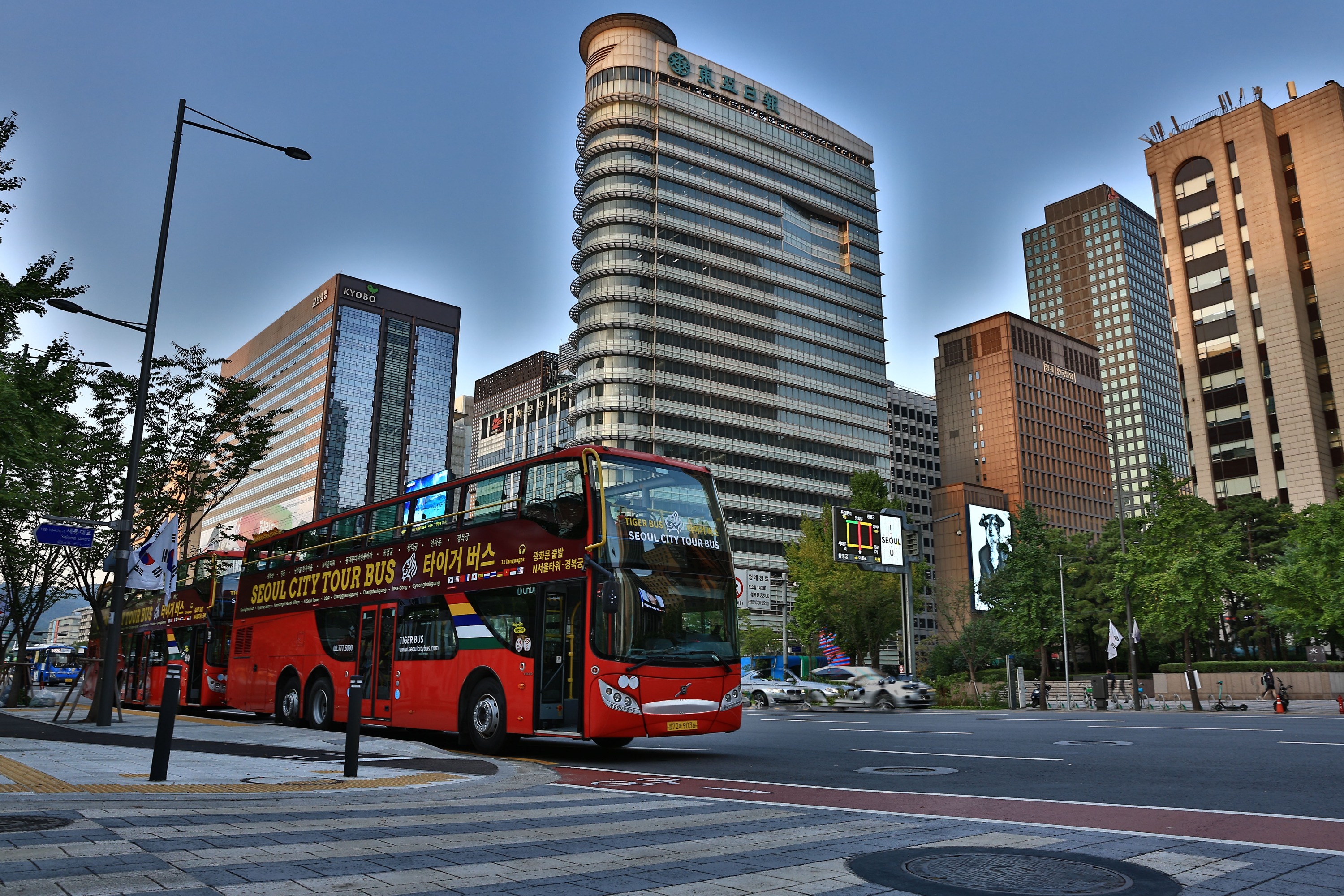
Find the stop. Every stop sign carries a five-digit stop ID. Put that number — or just the stop name — into Naver Map or Kakao Map and you get live arrival countdowns, the same feed as the LED display at major stops. On eight-lane roads, look for the island platform in the median: the busiest trunk routes use centre bus lanes, and the stop is in the middle of the road, reached by crosswalk.
Board at the front, tap. The reader beeps once for a normal fare, and tells you loudly if the card is empty. Top-up happens at any convenience store, not on the bus.
Press the red button, leave by the middle door, tap again. The exit tap is the step tourists skip, and it is the one that costs money: no exit tag means no free transfer and possibly a maximum distance fare.
The transfer, restated in one line
Tag off, board the next bus or subway within 30 minutes (60 between 21:00 and 07:00), free ride, up to four transfers — and taking the same route number twice is a new fare, not a transfer. That single rule is why a bus-subway-bus journey across Seoul costs 1,500 won and change rather than three separate fares.
What this guide is not about
The airport limousines (6001 and friends) are a separate system with their own tickets — the airport guide covers them. And intercity buses leave from terminals, not street stops. Everything on an ordinary Seoul street with a colour and a number, though, now reads like a map legend.
Colours, roles, fares, night-bus figures and the cash-free route count are from Seoul Metropolitan Government’s own transport pages, checked 4 September 2026. Fares last changed in August 2023; if they move again, the number on this page moves with them.