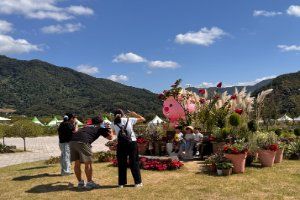
Two parks take almost all of Korea’s theme-park traffic, and they are not competitors so much as different answers. Everland is the big one: a hillside park an hour south of Seoul with five themed lands, a serious zoo, and the seasonal festivals that fill Korean social media. Lotte World is the convenient one: it sits on top of a subway station in Seoul, and its main hall has a roof.
Before either, the number that matters. Everland’s gate price in peak season is 68,000 won for an adult day pass. Almost nobody pays it. The same pass sells as a voucher for about USD 11, and Korean discount channels land between 23,000 and 27,000 won. Lotte World applies a 33 percent online discount as standard — around 43,900 won for the adult 1-Day — with vouchers near USD 27. Buying at the window is the single most expensive way to enter either park.
Everland, and a deadline
The park runs five themed zones — Global Fair, American Adventure, Magic Land, European Adventure and Zootopia — and its two headline draws are unusual for a theme park. One is T-Express, the wooden coaster people travel for. The other is the zoo: roughly 200 species and 2,000 animals, including Panda World, which needs no separate ticket beyond the day pass.
That is where the clock comes in. Fu Bao, the panda born here in 2020 who became a national character, returned to China in 2024. Her younger sisters Rui Bao and Hui Bao — twins born at Everland in July 2023, the first twin pandas born in Korea, now around 90 kilograms each — are being prepared for the same journey. Korean coverage in June 2026 reported the plan as this winter, before the hormonal changes that come with maturity, with the exact date still under discussion between Korean and Chinese specialists and some reports pointing to the first half of 2027. If seeing them matters to you, this season is the one with certainty in it.
Everland’s year is organised around festivals: tulips in spring, roses into early summer, Blood City — the country’s largest Halloween event, built around its Horror Maze — from September through November, then Christmas. Next door, Caribbean Bay is the water park (about USD 21), which makes an Everland trip a two-day proposition in summer.
Lotte World, and the complex around it
Lotte World’s advantage is geography and weather. It sits directly on Jamsil station (subway lines 2 and 8), which makes it a half-day you can decide on at breakfast, and its main hall is indoors — the reliable answer to a rainy day in Seoul, with the outdoor Magic Island on the lake for when it clears. Hours run 10:00 to 21:00, until 22:00 on Fridays and Saturdays.
The rest of the complex is the real argument for it. Under the same roof or a short walk away: the Lotte World Aquarium (55,000 animals across 650 species, about USD 19), Seoul Sky on floors 117–123 of the country’s tallest building (about USD 21, open to 22:00 and later at weekends), a folk museum, and a year-round ice rink. Bundled tickets covering several of these run around USD 19 and up, which is where the complex beats the park alone. Busan has its own Lotte World Adventure too, at about USD 26 — useful if you are heading south.
Choosing, briefly
Take Everland if you have a full day, want the coasters and the animals, or the pandas are the point — and accept the hour each way. Take Lotte World if the weather is bad, the day is short, or you want to stack an aquarium and an observation deck onto the same ticket. Families with small children usually find Lotte World gentler; teenagers usually want T-Express.
Either way, buy before you arrive. And if you go to Everland this autumn, the park is in Halloween mode from September — check what else is running in the region while you are out there on the live Gyeonggi calendar.
Park descriptions, zones, hours and facility details are from the Korea Tourism Organization’s official listings; ticket prices from the operators’ own channels and Korean coverage of 2026 pricing; voucher prices from the Klook catalogue; the panda timeline from Korean press reports of June 2026. Checked 8 September 2026. Panda plans in particular are unconfirmed until the operators announce a date — treat the winter timing as the current expectation, not a schedule.