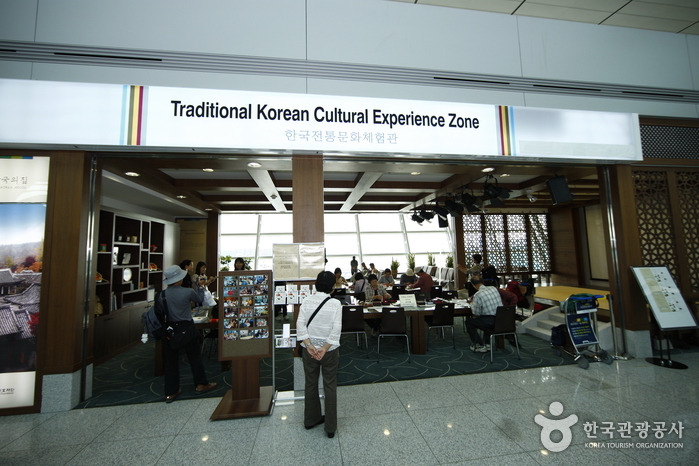
Three counters at the airport sell you three versions of the same promise, and none of them opens a Korean bank app. What one of them does give you is a Korean number that can receive a text code, which is a smaller and more useful thing than it sounds.
If you are standing in front of those counters trying to work out which SIM unlocks Korean websites, you are not going to find it. That is not what is for sale.
Two checks, one English phrase
Korean services run two different tests and English calls both of them verification.
The first is a code. A site texts six digits to a phone number and you type them back. Any number that can receive a Korean text message will do.
The second is 본인인증 (bon-in-injeung, “identity verification”). Here the site asks a Korean mobile carrier a question about you: does this number belong to a named, registered person? The answer only counts if it comes back attached to a 주민등록번호 (jumin-deungnok-beonho, “resident registration number”) for a Korean, or an 외국인등록번호 (oegugin-deungnok-beonho, “foreigner registration number”) for someone living here on a residence card.
Your passport is neither of those numbers. So a tourist line can hold a perfectly good Korean number and still come back empty when a bank asks about it.
Roaming
You keep your own number and your own carrier. Nothing about Korea changes that, and no Korean site can ask a question about a number registered in another country.
This matters less than people expect. The apps a visitor actually wants are largely the ones that take an overseas number by text message anyway, so roaming loses you very little. It is expensive, and it is the only option that works the second you land without touching anything.
Data-only eSIM
The most common thing sold to visitors, and the most commonly misunderstood. It gives you internet. There is a number attached somewhere in your phone settings, and it is not a number anyone can text you on.
Carriers say this plainly. LG U+ puts it on its tourist pages as a single line: if you use data-only services, SMS verification is not available. Nothing arrives, so there is nothing to type in.
For a week of maps, translation, messaging over the internet and ticket sites, that is genuinely enough, and most visitors never hit the edge of it.
A tourist line with a real 010 number
This is the option worth understanding properly, because the carriers are unusually specific about what it does.
LG U+ describes its voice and text products like this: SMS verification for restaurant and taxi reservation apps is available, but identity verification for banking or government services is not supported. KT tells buyers its tourist eSIM cannot be used for things like Naver authentication or online banking, while incoming service works normally. SKT says personal-authentication services are unavailable on its tourist eSIM.
Three carriers, the same sentence in three shapes. You get a Korean 010 number. Korean businesses can text you and ring you. The formal identity check stays shut.
That middle band is the entire value of paying more. A restaurant confirming a booking, a guesthouse asking where you are, a driver who cannot find the door: all of those need a number a Korean phone can dial, and all of them are ordinary daily friction on a trip.
One detail that catches people: incoming calls and texts are free on these plans, and outgoing ones are charged per message and per minute. You do not need to buy voice minutes to receive a code. On LG U+’s tour product the voice add-on starts at zero minutes for zero won, and the number still takes incoming calls and texts.
The passport check is not the check you are thinking of
Buy a tourist eSIM and you will be told to complete identity verification before calls and texts switch on. KT does this at its roaming centre in the airport. WOWPASS words it almost identically for its own eSIM: without identity verification, calls and texts will not be available and you can only use data, and after verifying your identity in Korea you will be able to receive calls and texts.
That step is the carrier confirming you are the person on the passport, so the line is not anonymous. It has nothing to do with whether a Korean website will recognise you later. Same words, different job, and it is the single most common reason someone buys the expensive SIM and then finds the bank app still refuses them.
Do it anyway, and do it before you leave the airport. Until it is done the number you paid for cannot receive anything.
One line per passport now
Korea has been tightening how phone lines are opened, because lines registered to someone else are the raw material for phone fraud.
From 6 July 2026, opening a new line or moving a number requires a face check against your ID, rolled out in stages across all three carriers and the budget operators. That first stage was built around Korean ID cards and driving licences, with the fallbacks being a government mobile ID app or a same-day resident registration extract. Foreign documents are on a separate track: the ministry says it is working with the Justice Ministry to verify them and has not published a completion date.
The part that reaches visitors is simpler. The number of lines that can be opened on a foreign passport has been cut from two to one, and the government says the one-line principle is being enforced more tightly, with extra lines only where a real need is shown. If your plan involved a SIM for your phone and a second for a hotspot or a travelling partner without their own passport to hand, rebuild the plan.
Where WOWPASS sits
It answers a different question. WOWPASS is a prepaid payment card that turns foreign cash or a foreign card into Korean money you can spend, and it earns its place in a bag for that reason alone. It sells an eSIM too, on SKT’s network, and that eSIM behaves exactly like the others described here.
Neither half of it verifies you to anyone. The card is covered separately, along with the gates it does not open.
Choosing
Data-only if the trip is short and nobody needs to ring you. A voice-capable tourist line if you have bookings that generate phone calls, or if you would rather a restaurant could reach you than discover at the door that it could not. Roaming if you land late, leave early, and would rather pay than fiddle.
What none of them changes is the thing most people are actually shopping for. The app-by-app picture is where that gets solved, and the good news there is that it has been getting steadily better without a Korean number being involved at all.
The carrier wording is quoted from LG U+’s English tourist SIM pages at lguplus.com, read on 12 September 2026, with KT’s and SKT’s equivalent tourist product statements checked the same day; the WOWPASS wording is from its own eSIM FAQ. The 6 July 2026 start for face verification at activation, its phased rollout and its fallbacks are from the Ministry of Science and ICT briefing published through the government policy portal on 30 June 2026 and press coverage of the launch. The reduction of passport-opened lines from two to one, and the stricter one-line-per-person principle, come from the same briefing. Prices and plan structures move constantly, so check the figure on the carrier’s own page before you pay.