Cherry blossom in Korea is a moving line, not a date. Flowers open on Jeju and the south coast in late March, and reach Seoul about a week later — in 2026, Seoul’s first bloom was declared on 29 March and the best viewing days were 7 to 10 April.
Two numbers do most of the planning work. Full bloom comes about seven days after first bloom, and one city gives you roughly a week of good viewing after that.
How the season actually moves
The bloom line runs south to north. In 2026 the forecast put Jeju’s first flowers around 22 March, the Jinhae festival opened on 27 March, Seoul’s tree flowered on 29 March, and Chuncheon followed in early April. The whole country, end to end, has blossom somewhere for about three weeks.
There is one official reference tree per city. Seoul’s bloom is “declared” when three or more flowers open on one specific king cherry at the Jongno weather observatory — the same tree line has been watched since 1922. That is why the news can name an exact day.
2026 ran early: six days ahead of 2025, ten days ahead of the thirty-year average of 8 April. Warm springs keep pulling the date forward, which is exactly why a fixed-date plan fails.
Planning before the forecast exists
Forecast maps for the coming spring appear from February, published by private weather companies and carried by every travel site. Once flowering starts, the Korea Meteorological Administration posts live first-bloom and full-bloom status from its observation trees on its weather portal.
Until February, the honest planning method is a window, not a day. Aim for the first ten days of April in Seoul and you would have hit the peak in most recent years — 2026 included. Book accommodation you can change, then shift your in-country days once the map is out.
Rain is the wildcard no forecast fixes. One hard rain at full bloom ends the show early. If the petals are falling, that is the famous part — go out anyway.
Seoul’s two festivals
여의도 (Yeouido) is the big one: about 1,900 cherry trees on the road behind the National Assembly, with the street closed to cars for the festival. In 2026 it ran 3 to 7 April. It is beautiful and extremely crowded — go before 10 a.m. or after dark, when the trees are lit.
석촌호수 (Seokchon Lake) wraps the blossom around a lake under Lotte World Tower, and ran 3 to 11 April in 2026 with performances and food trucks. The reflection shots come from here.
Neither needs a ticket. And the trees do not know where the festivals are: palace grounds, university campuses and any big park bloom in the same window with a fraction of the people.
Jinhae, if you want the full postcard
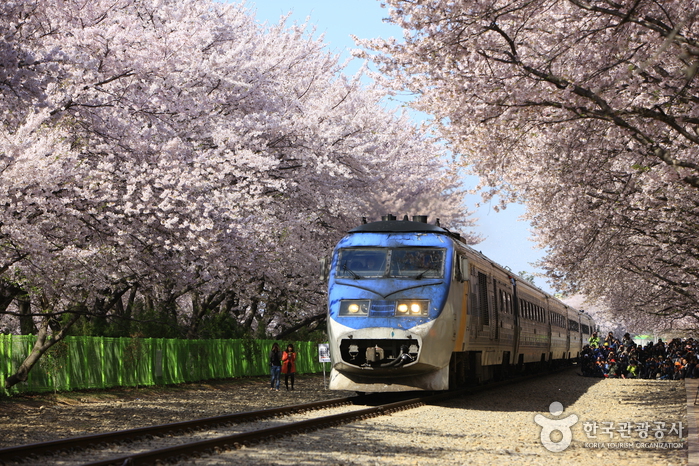
진해 (Jinhae), a naval district near Busan, holds the country’s biggest blossom event — the Gunhangje (군항제, “naval port festival”). The 64th edition ran 27 March to 5 April 2026 across the whole district, with a maritime fireworks show and a Black Eagles air display. Gyeonghwa Station, the train-tracks-under-blossom photo you have seen, is here.
It is a long way from Seoul. Do it as an overnight, or as a day trip from Busan, and expect the biggest crowds of the Korean spring on its weekends.
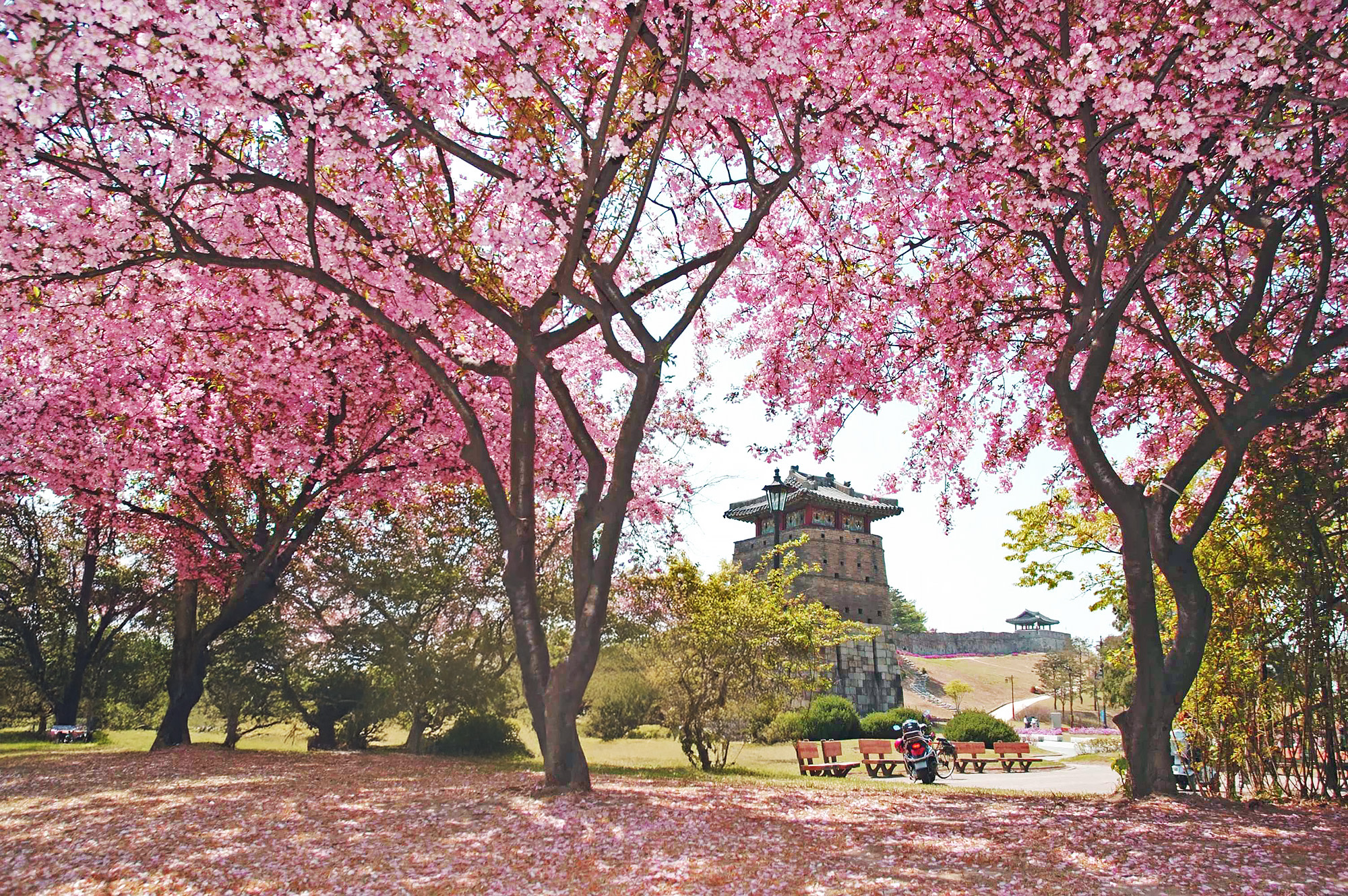
Tour operators sell blossom day trips in season — the Klook catalogue lists a Suwon Hwaseong Fortress blossom day tour from Seoul at about USD 58 and a Jeju small-group blossom tour at about USD 104, per the catalogue on 1 September 2026.
Written in September 2026, before the 2027 forecast exists. The 2026 dates above are what actually happened, checked on 2 September 2026; treat them as the pattern, and check a bloom map in February before you lock flights.